ODM Scent Library or Custom Development: Six Mistakes Beauty Brands Make
An ODM partner can put a scent on your shelf in two very different ways, and the mistake is rarely choosing the wrong one. The mistake is choosing late. A library-led route selects from fragrances that already exist, which compresses development and keeps cost predictable, at the price of exclusivity and of a scent that may already be circulating elsewhere. A developed route builds something the brand can own, which takes longer and asks more of the brief. Both are legitimate, and an established beauty brand usually needs both at once across a range. What decides the outcome is whether the split is settled before sampling starts, because after that point the brand is paying for work it may not be able to use.
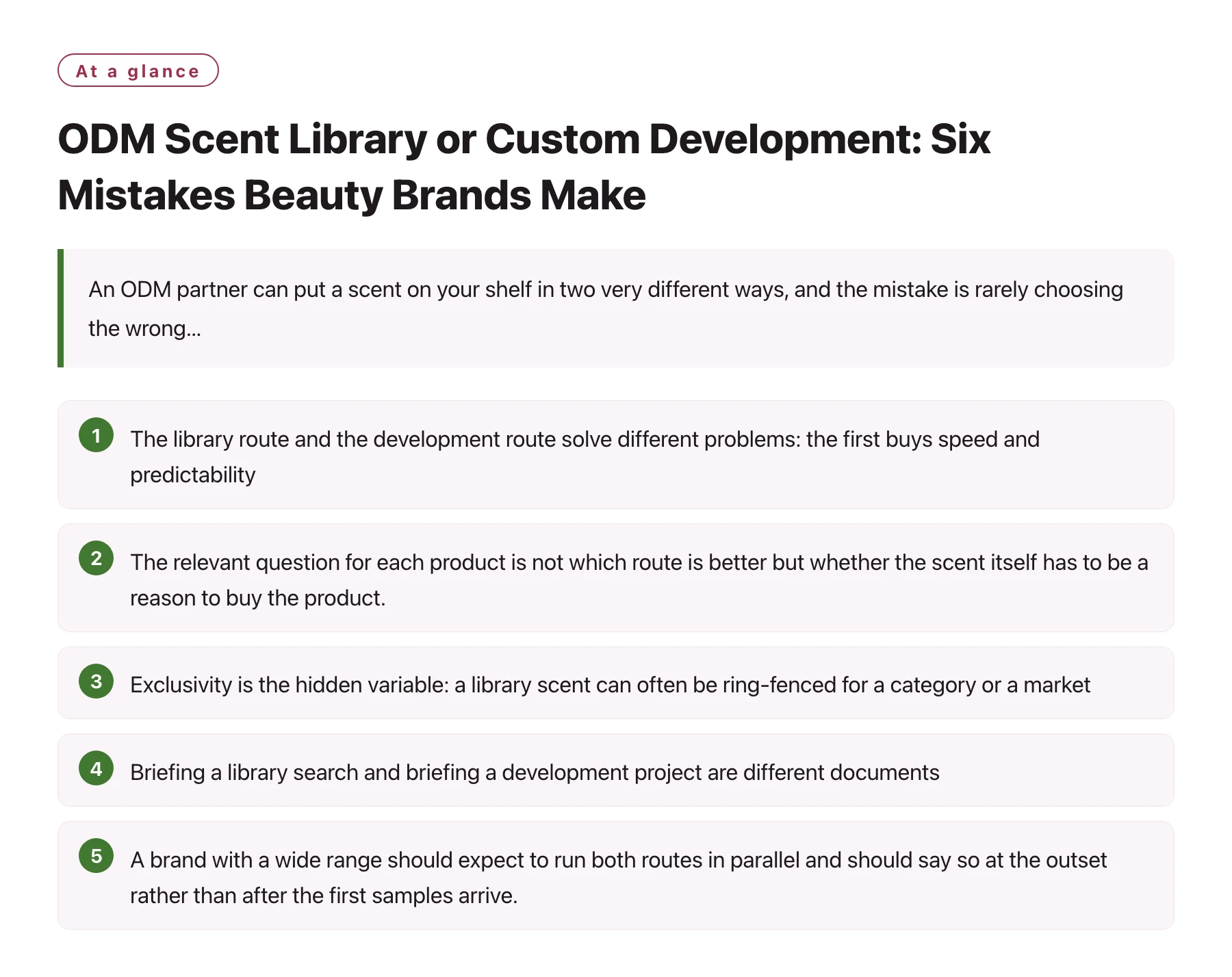
Key takeawaysThe library route and the development route solve different problems: the first buys speed and predictability, the second buys distinctiveness and control. · The relevant question for each product is not which route is better but whether the scent itself has to be a reason to buy the product. · Exclusivity is the hidden variable: a library scent can often be ring-fenced for a category or a market, and that negotiated scope is worth more than an assumption of ownership. · Briefing a library search and briefing a development project are different documents, and using one for the other wastes a full sample round. · A brand with a wide range should expect to run both routes in parallel and should say so at the outset rather than after the first samples arrive. · The cost of the development route is not only the perfumer's time; it is the additional rounds of approval, testing and packaging compatibility work that follow from a formula nobody has produced before.
The phrase full-service ODM covers a wide range of arrangements, from a manufacturer that offers a catalogue of existing fragrances with your label on them, to one that assigns a perfumer to a brief and develops something new for the brand. Brands that assume the second is what a serious ODM partner does, and the first is what a cheap one does, are working from a false hierarchy.
In practice, most established beauty brands need both. A body care line can carry a library scent that is fast, stable and inexpensive, while a signature fine fragrance in the same portfolio justifies a developed formula with an exclusivity scope attached. The failures that recur are not about the choice itself. They are about sequencing, briefing and assumptions, and they are avoidable.
This is written from the position of a product development lead at an established beauty brand who has run both routes in the same year and has had to explain to a finance team why one of them cost three times as much.
Where the two ODM routes actually diverge
| Decision point | Library-led route | Developed route | What it changes for the brand |
|---|---|---|---|
| Starting material | A shortlist from fragrances the manufacturer has already compounded and produced | A brief handed to a perfumer, with direction, references and constraints | The library route starts from what exists; the developed route starts from what the brand can articulate |
| Time to first evaluation | Days rather than weeks, because no formulation work is required | Depends entirely on how clear the brief is and how many directions are explored | Only the developed route can be delayed by a vague brief |
| Cost structure | Mostly search, sampling and adaptation of an existing formula | Development time, multiple rounds, plus testing on a formula with no production history | The developed route buys a different kind of asset, not a more expensive version of the same one |
| Exclusivity | Usually negotiable within a category, channel or territory | Can be written into the agreement as a full or scoped assignment | A negotiated library restriction is often sufficient and far cheaper than ownership |
| Technical risk | Low, because the formula has been produced and filled before | Higher for stability, colour and packaging interaction until the formula is proven | Newness is a technical commitment as well as a creative one |
| What the brand ends up with | A scent chosen with judgement, quickly | A scent the brand can defend as its own | Both can be commercially correct answers to the same category question |
The useful way to read this table is by column three. Every consequence follows from whether the formula already exists, not from how much the manufacturer charges. A brand that wants to see how a partner handles both routes can look at published project notes first, since examples of fragrance projects tend to show which route was used and why.
Six mistakes that recur on both routes
- Briefing a library search as though it were a development projectA library request should describe an occasion, a category and an olfactory territory. Writing a full development brief for a catalogue search produces a long wait and a shortlist that misses the point.
- Assuming a library scent is automatically non-exclusiveRestrictions can frequently be negotiated by category, market or duration. Asking is cheap; assuming either way is not, because a brand may pay for development it did not need.
- Splitting the range after the first sample roundDeciding which products are library-led and which are developed once sampling is underway means paying for development work on products that will never use it.
- Treating the brief as a mood boardA development brief has to state what the fragrance must do: where it sits in the range, what it must not resemble, which formats it will be filled into, and which markets it must satisfy.
- Forgetting the packaging interactionA new formula still has to live in the chosen bottle, cap and pump. Compatibility work belongs in the development timeline, not in the week before filling.
- Comparing the two routes on unit price aloneThe routes carry different development costs and different long-run flexibility. A single unit price hides which of the two the brand has actually bought.
Underneath several of these mistakes is the same assumption: that the scent is a creative object first and a manufactured product second. A manufacturer works from the opposite direction, which is why an established beauty brand gets further by stating the manufacturing and market constraints early and letting the creative direction work inside them. The wider scope of what full ODM fragrance service can include is worth reading before the brief is written, because it sets the boundary of what is being chosen between.
A quick internal test before the brief goes out: write one sentence for each product saying why a customer would buy it, and mark whether the scent is part of that reason. Products where the scent is the reason belong on the developed route. Products where the scent supports a format, a price point or a claim belong on the library route, and spending development money there is usually a misallocation. Running both routes together is easier with a custom fragrance development partner who can hold the whole range in one brief. Consumer direction shifts faster than a development cycle, which is one reason library-led ranges stay useful for fast-moving categories, as trend reporting from research houses such as Mintel repeatedly illustrates [1]. Where a library shortlist is being judged, having a shared vocabulary for the materials involved helps a brand describe what it is smelling rather than simply liking it [2].
Sources
- Mintel Press Centre —— Mintel's press releases on consumer and beauty market research, including fragrance and personal care trend reporting.
- The Good Scents Company —— A reference database of aroma materials with odour descriptions, CAS numbers and typical usage information.
Frequently asked questions
What is the difference between a scent library and custom ODM development?
A scent library is a set of fragrances the manufacturer has already formulated and produced; the brand selects and adapts. Custom development starts from a brief and assigns perfumery work to create something new. The first is faster and cheaper, the second is more distinctive and more controllable.
Can a library scent be made exclusive to one brand?
Often yes, within a defined scope such as a product category, sales channel or territory, and sometimes for a fixed period. It has to be negotiated and written into the agreement, and the scope matters more than the word exclusivity on its own.
How many development rounds should a brand budget for?
Plan for more than one. A well-written brief usually converges in two or three evaluation rounds, while a brief built from mood references alone tends to consume rounds without converging. Budgeting rounds is easier than budgeting perfumer hours.
Is custom development always the better long-term choice?
No. Development buys distinctiveness, control and an asset the brand can defend, and it also carries higher technical risk and cost. For products where the scent supports the format rather than defines it, a well-chosen library fragrance is frequently the better commercial decision.
When should the decision between the two routes be made?
Before sampling starts, and ideally per product rather than for the range as a whole. Deciding after the first samples arrive means the brand has already funded development work for products that will never use it.