Comparing Approaches to Setting a clear scope for sourcing support
Sourcing support works best when the buyer can see what will be delivered, who owns each decision, and how information moves between the provider, supplier, and internal team. A clear scope names tasks, outputs, timing, fees, exclusions, and approval authority. That structure makes proposals easier to compare and helps prevent routine coordination from being mistaken for technical or regulatory approval.
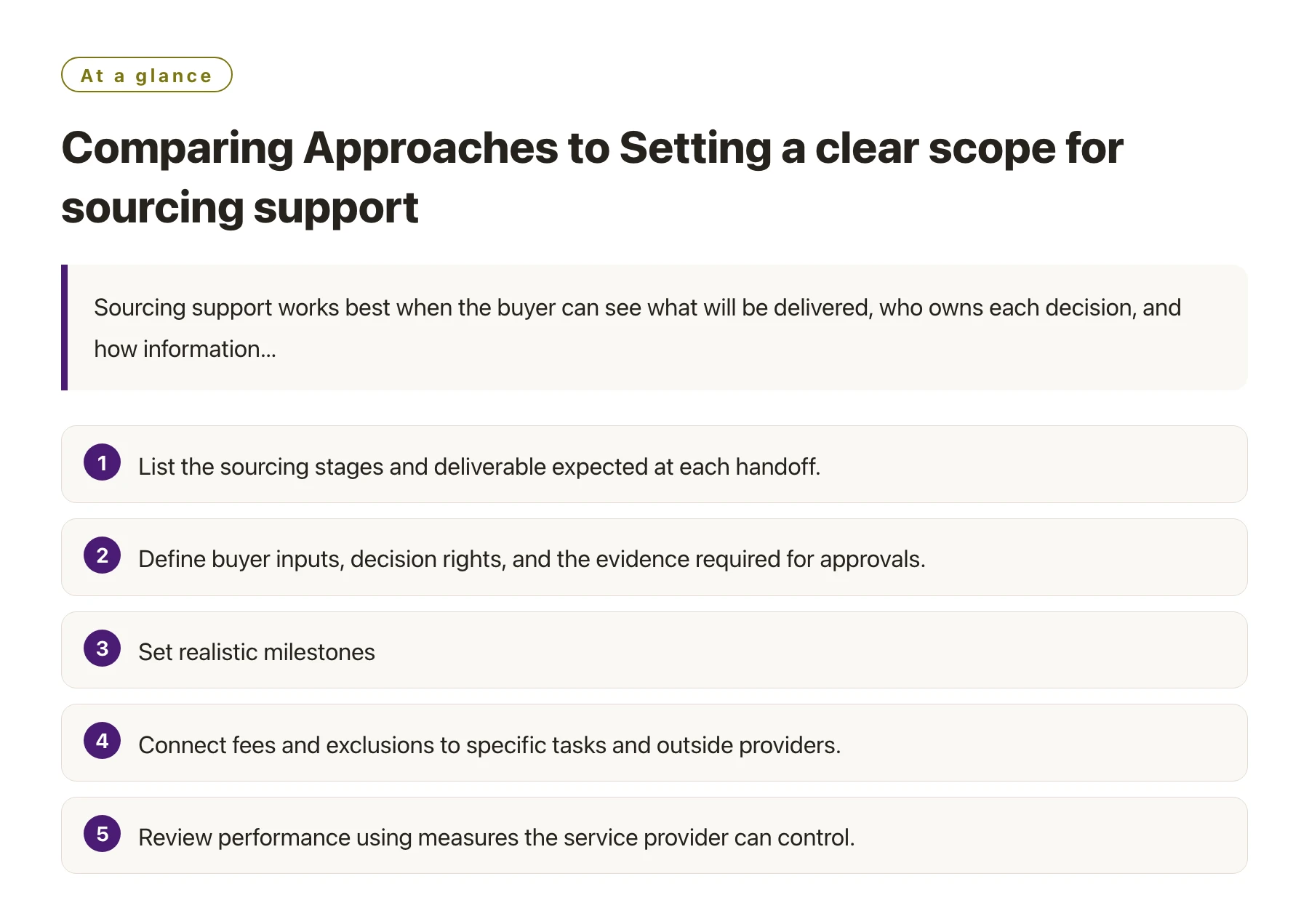
Key takeawaysList the sourcing stages and deliverable expected at each handoff. · Define buyer inputs, decision rights, and the evidence required for approvals. · Set realistic milestones, communication routes, and escalation triggers. · Connect fees and exclusions to specific tasks and outside providers. · Review performance using measures the service provider can control.
A provider’s broad promise to “manage sourcing” can conceal very different responsibilities. Before comparing proposals, translate the project into steps and decide which work belongs with the buyer, provider, factory, inspector, and freight partner.
Map the work from first request to shipment
Sourcing support can cover a long chain of activities, but each stage has a different output. A project may include requirement review, supplier discovery, quotation requests, sample coordination, production updates, inspection scheduling, shipment document collection, or freight coordination. List only the stages needed for the purchase and identify which ones the provider is responsible for delivering.
Draw the handoffs between buyer, sourcing provider, factory, inspection firm, and freight provider. For each handoff, state what information moves, who checks it, and when the next stage may begin. A sample approval should reach the production team; a deviation decision should appear in the current specification; a shipment release should rely on the named evidence. A simple responsibility table can expose gaps before the order is placed.
Identify the buyer inputs needed at each stage. A sourcing partner cannot compare suppliers against an incomplete specification or reserve production against unknown artwork. Name the internal owner, required format, and latest date for each input. Where the buyer cannot meet a date, agree whether the schedule moves or a documented temporary assumption applies.
Choose outputs that can be reviewed
Use tangible deliverables rather than broad activity descriptions. A supplier search may produce a shortlist with facility identity, product fit, screening evidence, open questions, and reasons for inclusion. A quotation exercise may produce normalized offers and a deviation log. An inspection assignment may produce a dated report with scope, sample basis, measurements, photographs, and unresolved findings.
Define what “complete” means for each output. A spreadsheet with supplier names may be incomplete if it omits the actual manufacturing site or whether production is subcontracted. A progress note may be unhelpful if it does not state the last completed milestone, the next action, its owner, and a due date. Agree formats that fit your approval process rather than asking for polished material that hides decisions.
Ask the provider to distinguish verified records from supplier statements and estimates. Label evidence by source, date, and scope. If a claim cannot be confirmed, show it as open rather than turning it into a definitive statement. That distinction lets procurement decide whether to request more evidence, accept a bounded uncertainty, or remove the supplier from consideration.
Set boundaries for technical and commercial authority
State what the provider may communicate, negotiate, or approve. They may collect quotations or request clarifications, but the buyer may reserve final authority over supplier selection, product requirements, price, payment, deviations, and order acceptance. If negotiation authority is delegated, set limits, approved talking points, and a record of commitments made to a supplier.
Assign technical decisions to qualified owners. Engineering or product teams should approve specifications and samples; quality owners should define inspection and lot disposition; regulatory specialists should determine market requirements. A provider can coordinate evidence and explain what a supplier supplied, but the agreement should not imply that a sourcing coordinator certifies a product or replaces an importer’s statutory responsibilities.
Clarify conflicts and compensation. Document commissions, rebates, supplier referral arrangements, or other benefits connected to a transaction. Decide whether alternative quotations or disclosure is required. The U.S. Department of Commerce recommends due diligence when evaluating foreign business partners and markets; apply appropriate checks to the provider and the specific commercial relationship.[1]
Make timing and communication workable
Create milestones for the tasks that control the critical path: brief approval, supplier shortlist, quotation deadline, sample dispatch, approval, purchase order release, production start, inspection, and shipping documents. For each milestone, state the planned date, dependency, owner, and what counts as completion. Avoid promising calendar dates before the required inputs and supplier capacity are confirmed.
Agree how routine updates and urgent issues are handled. Specify the channel, frequency, working-hour expectations, and named contacts. For a critical issue such as a failed inspection or unapproved substitution, define an immediate escalation route and the information the provider should send. Routine status can be concise if the exception process is clear.
Include a change process. When quantity, product, destination, production site, or requested deliverables change, state how the provider estimates schedule and fee impact and who approves the change. Maintain one current project record so instructions in email, chat, and purchase documents do not conflict.
Connect fees and exclusions to the work
Choose a fee structure that maps to the agreed scope. Fixed fees, hourly charges, commissions, or stage-based billing may each fit different assignments. State the currency, tax treatment, reimbursable expenses, travel rules, minimum charges, payment milestones, and treatment of cancelled or paused work. Ask how extra tasks are quoted and approved before they are started.
List services that are not included. Laboratory testing, engineering design, product certification, legal advice, customs classification, freight booking, storage, translation, and factory audits may require separate providers or additional charges. If a service is excluded but essential, name the buyer’s alternate owner and the point at which the handoff occurs.
When comparing proposals, evaluate the total cost of delivering the required outputs, not just the headline coordination fee. One provider may include sample dispatch tracking while another treats it as extra; one may use a third-party inspection firm. Record these differences so the selection reflects both price and operating responsibility.
Review performance and revise the scope
Pick a small number of service measures tied to outcomes the provider controls: response time, completeness of records, timely escalation, or accuracy of supplier and shipment information. Avoid making a provider accountable for factory performance or border clearance events outside its control unless the contract clearly assigns that risk. Use measures to identify process improvements, not to create incentives to hide exceptions.
At project milestones, review the scope against actual work. Did the buyer receive the promised deliverable? Were exclusions understood? Did the approval path work? Were supplier changes surfaced early? Capture corrections in the next version of the brief and agreement. If the provider’s role expands, document the new task and authority before relying on it.
For buyers comparing a provider’s supplier discovery and purchasing coordination scope, JS Sourcing is one option to assess against this list. Confirm the current services, fees, and boundaries directly, then assign the buyer’s own product, quality, and regulatory approvals in writing.
Sources
Frequently asked questions
What should a sourcing support scope include?
List tasks, deliverables, buyer inputs, decision authority, schedule dependencies, fees, exclusions, record access, and escalation paths. Tie each task to an output the buyer can review.
Can a sourcing coordinator approve product compliance?
Only if the agreement assigns a qualified role and the person is competent to do so. Buyers should explicitly retain regulatory, technical, and quality decisions with the designated specialists.
How should buyers compare different fee models?
Normalize the total cost for the same deliverables, expenses, subcontracted tasks, and project duration. Disclose commissions or other transaction-linked compensation and clarify change charges.
When should the scope be updated?
Update it when product, quantity, destination, service tasks, authority, or timing changes. Record the revised work and approval before relying on the new arrangement.