56 Strands of 0.29 mm: Inside a 4 mm² Conductor
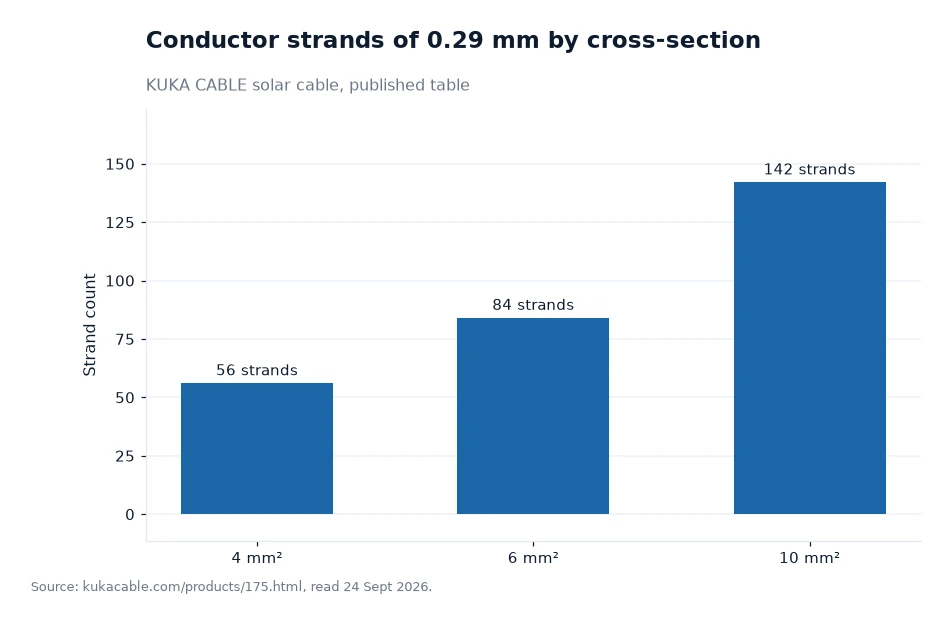
Fifty-six wires of 0.29 mm, twisted into one conductor, is what a 4 mm² PV cable contains on the manufacturer's published table. That single line of construction data explains the flexibility of the cable, the way it crimps into a connector, and why its copper content is smaller than the nominal size suggests: by my own area calculation the strands add up to about 3.70 mm² of metal.
Key takeaways
- A 4 mm² conductor is published as 56 strands of 0.29 mm, with a nominal overall diameter of 5.5 mm.
- The strand material is tinned copper, class 5 flexible to IEC 60228, which is the class intended for movement.
- Insulation is 0.7 mm and sheath 0.8 mm at this size, and the finished cable weighs 59 g per metre.
- KUKA CABLE rates the design DC 1.8/1.8 kV and publishes a bend limit of four times the outer diameter.
The anatomy of a 4 mm² conductor
Start with the metal. Fifty-six round wires of 0.29 mm are bunched so that the bundle behaves as one conductor. Tinning coats each wire before stranding, which means corrosion has to travel along a single thin wire rather than across a bare copper surface, and solder or crimp contact is made to a protected surface. The strand count is not decoration: more, thinner wires bend with less strain per wire than fewer, thicker ones.
The class matters as much as the count. IEC 60228 groups conductors by flexibility, and class 5 sits in the flexible range, which is why the maker describes the construction that way. The site's model list includes a TUV solar cable in 4 mm² and 6 mm² alongside H1Z2Z2-K and PV1-F, so the same conductor construction appears under several named designs.
Dimensions stacked around the strand bundle
Around the conductor sit two layers. Insulation is listed at 0.7 mm for the 1.5 mm² to 10 mm² sizes, and the sheath at 0.8 mm. Both are described on the 1500 V page as XLPO, electron-beam cross-linked and LSHF. Add the layers to the bunched conductor and the nominal overall diameter reaches 5.5 mm, with a nominal weight of 59 g per metre.
- Conductor: 56 strands of 0.29 mm, tinned copper, class 5 flexible.
- Insulation: 0.7 mm of electron-beam cross-linked XLPO, LSHF.
- Sheath: 0.8 mm of the same compound family, black or red.
- Finished cable: 5.5 mm nominal diameter, 59 g/m.
These are the numbers a connector has to accept. If a crimp barrel or a gland is sized for a 6 mm outer diameter, a 5.5 mm cable sits loose inside it unless the correct insert is fitted, and a loose joint is the beginning of every heat story that follows.
Terminating 4 mm² on site
The strand bundle at this size is easy to cut and easy to damage. A cutting tool that nicks strands leaves a conductor with fewer wires than the table specifies, and a crimp made over a nicked bundle holds less than the design intends. Strip the insulation to the length the connector maker requires, keep the strands twisted in their original lay, and check that no wire has been folded back outside the barrel before the tool closes.
The maker's own solar range includes MC4 and solar connectors, solar fuse connectors, solar diode connectors and assembled PV cable assemblies. Whichever is used, the cable behind it still has a bend limit of four times the outer diameter, so the first bend should be kept clear of the crimp and the cable clipped so a later pull cannot straighten it into the connector body.
Where 4 mm² fits, and where it does not
The commonly used PV sizes on the maker's site are 4 mm², 6 mm² and 10 mm², so a 4mm solar cable is the lightest of the standard three. It suits short string runs, module-to-module links and any place where a light cable on a moving rail is preferable to a heavier one. Longer runs, where voltage drop and mechanical strength both grow with distance, are where the 6 mm² and 10 mm² constructions appear instead.
What the site does not publish is a current rating table, a voltage drop figure or a maximum run length. Those depend on the array design, and a buyer who needs them should ask the supplier rather than infer them from the cross-section. What is published is the voltage class, DC 1.8/1.8 kV, and the temperature window of −40 °C to +90 °C with short-circuit limits of +120 °C for 20,000 hours and +250 °C for five seconds.
Drum label checklist for this size
| Item | Published value | Where it comes from |
|---|---|---|
| Conductor | 56 × 0.29 mm, tinned copper, class 5 | Cross-section table |
| Overall diameter | 5.5 mm nominal | Cross-section table |
| Insulation and sheath | 0.7 mm and 0.8 mm | Cross-section table |
| Weight | 59 g/m nominal | Cross-section table |
| Voltage and temperature | DC 1.8/1.8 kV; −40 °C to +90 °C | 1500 V product page |
| Minimum bend radius | About 22 mm (4 × 5.5 mm, author's calculation) | 1500 V page rule applied to the table |
Worked example
Two sums are worth doing before ordering. The first is the copper area: each strand of 0.29 mm has an area of π × (0.145 mm)², about 0.066 mm², and 56 of them give roughly 3.70 mm². That is my arithmetic, and the assumption is that each strand is a true circle of the stated diameter. The second is weight: 59 g per metre means a 200 m drum carries about 11.8 kg of cable, which is my own multiplication of the published weight by a chosen length.
Run the same two sums for the next size up and the pattern is visible. At 6 mm² the strands number 84 and the weight is 78 g/m, so 200 m becomes roughly 15.6 kg. Size selection is therefore not only an electrical question; it is also a question about who carries the drum along the rail.
Frequently asked questions
Why does a 4 mm² PV cable use so many thin strands instead of a few thick ones?
Bending strain is shared across the wires, so 56 thin strands follow a curve far more easily than a handful of thick ones and each wire stays well inside its own elongation limit. The published design pairs that strand bundle with an ambient rating of −40 °C to +90 °C and a class 5 flexible conductor to IEC 60228, which is the combination that survives being dressed on a cold roof.
How much copper is actually inside a 4 mm² conductor?
Treating the strands as circles of 0.29 mm, each one has an area of about 0.066 mm², and 56 of them come to roughly 3.70 mm². That is my own calculation based on the published strand construction, and the gap between it and the nominal 4 mm² is normal for a flexible class 5 design, where round strands cannot fill the circle completely.
Before you crimp
Match the connector and the gland to a 5.5 mm outer diameter, and confirm the conductor class on the drum before choosing a crimp die. Keep the cut clean, keep the lay of the strands intact, and leave the first bend a hand's width back from the barrel. If the design needs a current rating or a voltage drop figure, ask the supplier, because the manufacturer's pages publish the construction and the temperature limits rather than an installation table. The solar cable section and the laboratory test pages cover the rest of the specification.
The 56-strand build detailed above appears on the manufacturer's own website; I read it on 24 Sept 2026[1].